
Understanding the normal sperm count to get pregnant is one of the first things couples should know when they start trying to conceive. Male fertility plays an equal role in conception, yet it is often overlooked until pregnancy becomes a challenge.
This guide breaks down exactly what the numbers mean, what the World Health Organization (WHO) considers a healthy range, and what you can do if your sperm count falls below that threshold. Whether you’re just starting out or have been trying for a while, this information can help you and your partner make informed decisions.
Let’s start with the basics.
What Is Sperm Count and Why Does It Matter?
Normal sperm count to get pregnant ,Sperm count refers to the total number of sperm cells present in one millilitre (mL) of semen. It is one of the key parameters evaluated in a semen analysis, along with sperm motility, morphology, volume, and pH.
During natural conception, only one sperm needs to fertilise the egg but getting that one sperm to its destination requires millions of competitors. A higher count simply increases the odds that at least one healthy, motile sperm will successfully reach and penetrate the egg.
Even if your count is within the normal range, other factors like motility (how sperm swim) and morphology (the shape of sperm) are equally important. That said, sperm count remains one of the most direct indicators of male fertility.
What Is the Normal Sperm Count to Get Pregnant?
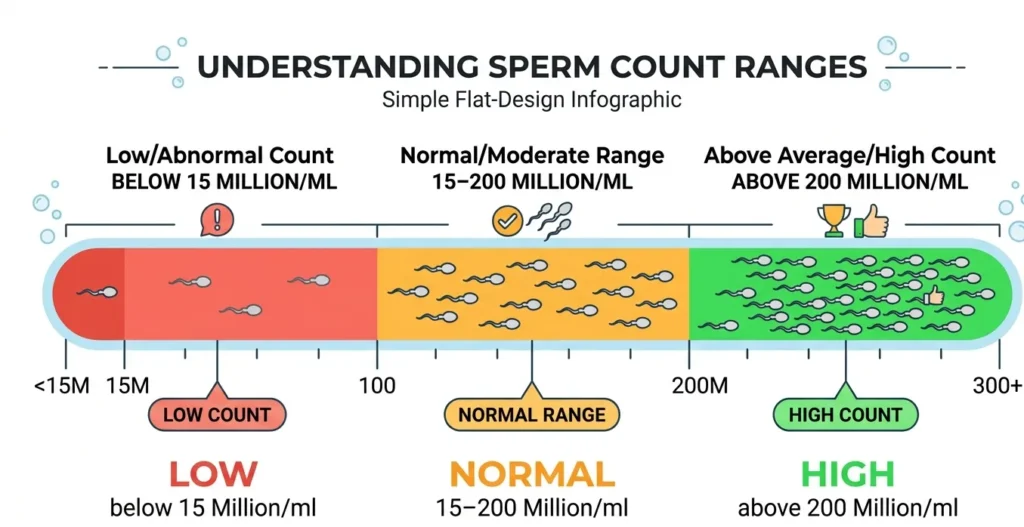
According to the World Health Organization (WHO) 2021 reference values, the normal sperm count to get pregnant is at least 16 million sperm per millilitre of semen, or a total sperm count of 39 million per ejaculate.
Here is a quick reference breakdown:
| Parameter | WHO 2021 Lower Reference | Optimal Range |
| Sperm concentration | 16 million/mL | 40–300 million/mL |
| Total sperm count | 39 million/ejaculate | 80–300 million |
| Sperm motility (progressive) | 30% | ≥ 50% |
| Sperm morphology (normal forms) | 4% | ≥ 14% |
| Semen volume | 1.4 mL | 2–6 mL |
Source: WHO Laboratory Manual for the Examination and Processing of Human Semen, 6th Edition (2021)https://www.who.int/publications/i/item/9789240030787
It’s worth noting that having a normal sperm count to get pregnant does not guarantee immediate conception. It simply means your numbers fall within the range where natural pregnancy is statistically achievable. Many other biological and lifestyle factors come into play.
Understanding Low Sperm Count (Oligospermia)
When sperm concentration drops below 16 million/mL, the condition is medically known as oligospermia. Severe oligospermia is when the count falls below 5 million/mL, and azoospermia refers to the complete absence of sperm in semen.
Low sperm count alone does not mean a man cannot father a child many men with slightly low counts do conceive naturally. However, the lower the count, the harder it becomes for sperm to successfully fertilise an egg.
Common Causes of a Below-Normal Sperm Count
Several factors can contribute to a lower-than-normal sperm count to get pregnant, including:
- Varicocele (swollen veins in the scrotum) — the most common reversible cause
- Infections such as epididymitis or orchitis
- Hormonal imbalances (low testosterone, high prolactin, thyroid issues)
- Exposure to heat (laptops on lap, hot baths, tight underwear)
- Excessive alcohol, tobacco, or recreational drug use
- Obesity and poor metabolic health
- Certain medications (anabolic steroids, chemotherapy)
- Undescended testicles or prior surgeries
- Chronic stress and sleep deprivation
How Normal Sperm Count Affects Your Chances of Getting Pregnant
Research consistently shows that achieving a normal sperm count to get pregnant significantly improves the chances of natural conception within 12 months of trying. Studies published in journals like Fertility and Sterility suggest that couples where the male partner has a total motile sperm count above 20 million have much higher cumulative pregnancy rates compared to those with lower counts.How to Increase Sperm Count Naturally: 12 Proven Nutrition Strategies
Here’s a simplified way to think about it: the more motile, healthy sperm that are present, the more ‘candidates’ there are to complete the journey to the egg. Even after ovulation, sperm can survive in the female reproductive tract for up to 5 days. Having a robust count means more sperm are available during that fertile window.
Sperm Count vs. Sperm Motility: Which Matters More?
Both matter — but for different reasons. Sperm count tells you how many sperm are present. Sperm motility tells you how many of those sperm can actually swim toward the egg. A man could have a high sperm count but poor motility, which would still make conception difficult.Food to Increase Sperm Count: 15 Best Foods for Male Fertility
The parameter that fertility specialists pay close attention to is Total Motile Sperm Count (TMSC): total sperm count × % motility. An TMSC above 20 million is generally considered favourable for natural conception.
How to Improve Sperm Count Naturally to Improve Fertility
If your sperm count is below the normal range needed to get pregnant, there is often a lot you can do especially if the cause is lifestyle-related. Sperm take approximately 74 days (about 2.5 months) to mature, so any positive changes you make today can meaningfully improve your count within 3 months.
Eat a Fertility-Supporting Diet
Nutrition plays a direct role in sperm production. Focus on foods rich in antioxidants, zinc, selenium, folate, and omega-3 fatty acids. These nutrients protect sperm from oxidative damage and support healthy testosterone levels.
- Zinc: found in pumpkin seeds, oysters, beef, and lentils
- Selenium: found in Brazil nuts (just 2 per day covers your needs), eggs, and fish
- Vitamin C and E: powerful antioxidants from citrus fruits, bell peppers, almonds, and sunflower seeds
- Folate: found in dark leafy greens, chickpeas, and fortified cereals
- Omega-3 fatty acids: found in walnuts, flaxseeds, and fatty fish like salmon
- Lycopene: found in cooked tomatoes and watermelon — associated with improved sperm motility
Lifestyle Changes That Can Boost Your Sperm Count
Making these adjustments can have a measurable impact on sperm production:
- Maintain a healthy weight — obesity is linked to lower testosterone and higher oestrogen levels
- Exercise regularly — moderate activity (not extreme endurance training) is associated with higher sperm counts
- Reduce scrotal heat — avoid hot tubs, saunas, and laptop use on the lap
- Quit smoking — cigarette smoke introduces oxidative stress that directly damages sperm DNA
- Limit alcohol — heavy drinking suppresses testosterone and impairs sperm production
- Prioritise sleep — testosterone peaks during sleep; chronic poor sleep lowers it
- Manage stress — elevated cortisol negatively affects sperm-producing hormones
Evidence-Based Supplements for Male Fertility
While food should always come first, certain supplements have shown promise in clinical research for improving sperm count and overall semen quality. As a certified supplement specialist, I recommend discussing these with your doctor before starting:https://www.ncbi.nlm.nih.gov/books/NBK562258/
- Coenzyme Q10 (CoQ10): a powerful antioxidant that has shown improvements in sperm concentration and motility in randomised controlled trials
- Ashwagandha (KSM-66 extract): adaptogen associated with increased sperm count and testosterone in stressed men
- Zinc + Folate combination: shown to improve sperm concentration in subfertile men
- Vitamin D: low levels are associated with poor semen quality; supplementation may improve sperm motility
- L-Carnitine: may improve sperm motility and count, particularly in men with oligospermia
When Should You See a Doctor About Sperm Count?
If you and your partner have been trying to conceive for 12 months (or 6 months if she is over 35) without success, it’s time to seek a fertility evaluation. A standard semen analysis is a simple, non-invasive test that can quickly determine whether a normal sperm count to get pregnant is present.
You may want to see a doctor sooner if you have a history of:
- Testicular trauma or surgery
- Prior sexually transmitted infections
- Known hormonal disorders
- A history of using anabolic steroids
- Erectile or ejaculatory dysfunction
A reproductive endocrinologist or urologist can identify underlying causes and recommend targeted treatments — whether that’s medication, lifestyle changes, varicocele repair, or assisted reproductive technologies like IUI or IVF with ICSI.
Normal Sperm Count Requirements for IUI and IVF
If natural conception hasn’t worked, understanding what sperm count is needed for fertility treatments can help you plan your next steps.
Intrauterine Insemination (IUI)
For IUI, most clinics look for a post-wash total motile sperm count (TMSC) of at least 5–10 million. Below this threshold, IUI success rates drop significantly and IVF may be recommended instead.
In Vitro Fertilisation (IVF)
For standard IVF, a post-wash count of 100,000–2 million motile sperm is generally sufficient. For men with very low counts, ICSI (Intracytoplasmic Sperm Injection) — where a single sperm is directly injected into an egg — can be performed with extremely low counts or even sperm retrieved surgically.
Key Takeaways About Normal Sperm Count to Get Pregnant
- The WHO-defined normal sperm count to get pregnant is at least 16 million sperm/mL or 39 million per ejaculate.
- Sperm count is only one part of male fertility — motility, morphology, and semen volume all matter.
- Low sperm count (oligospermia) doesn’t rule out natural conception, but it does reduce the odds.
- Lifestyle factors like diet, exercise, sleep, and avoiding heat and toxins can meaningfully improve count within 3 months.
- If you’ve been trying for 12 months (or 6 months for women over 35), get a semen analysis — it’s quick and informative.
- Fertility treatments like IUI, IVF, and ICSI remain effective options even when sperm count is significantly low.
Frequently Asked Questions (FAQ)
What is the minimum sperm count to get pregnant naturally?
The minimum normal sperm count to get pregnant naturally, according to WHO 2021 guidelines, is 16 million sperm per millilitre of semen, or a total of 39 million per ejaculate. Counts below this threshold reduce but do not eliminate —the chance of natural conception. Many other factors, including sperm motility, morphology, and the female partner’s fertility, also influence outcomes.
Can a man with a low sperm count still get a woman pregnant?
Yes, absolutely. Men with mildly or moderately low sperm counts can and do achieve natural pregnancies. The probability is lower compared to men with optimal counts, but it is not zero. If the count is very low (below 5 million/mL), assisted reproductive techniques such as IUI or IVF with ICSI significantly improve the chances.
How quickly can sperm count improve?
Sperm take approximately 74 days to mature fully in a process called spermatogenesis. This means lifestyle or dietary changes you make today may start showing up in your semen analysis results in about 2.5 to 3 months. Consistency is key sustained healthy habits lead to the most meaningful improvements in sperm count and quality
Does age affect sperm count?
Yes, male fertility does decline with age, though less dramatically than female fertility. After the age of 40, sperm count, motility, and DNA integrity tend to decline. This can result in longer time to conception and a slightly higher risk of miscarriage or certain conditions in the child. Maintaining a healthy lifestyle can help mitigate age-related declines in sperm quality.
How is sperm count tested?
Sperm count is measured through a semen analysis, also called a seminogram. You provide a semen sample usually collected by masturbation at a clinic or at home using a special collection kit which is then examined under a microscope by an andrologist. The test measures concentration, total count, motility, morphology, volume, and pH. For accurate results, abstaining from ejaculation for 2–5 days before the test is recommended.
Can stress affect sperm count?
Yes. Chronic psychological stress elevates cortisol, which can suppress the hypothalamic-pituitary-gonadal axis the hormonal chain responsible for testosterone production and sperm development. Research published in Fertility and Sterility has shown associations between high stress levels and lower sperm concentration and motility. Stress management strategies like adequate sleep, meditation, and regular exercise can help protect sperm health.
What foods increase sperm count?
Foods that support a normal sperm count to get pregnant include pumpkin seeds (high in zinc), Brazil nuts (selenium), eggs, spinach and dark greens (folate), cooked tomatoes (lycopene), walnuts and flaxseeds (omega-3 fatty acids), and oysters (zinc and B12). Avoiding processed foods, trans fats, and excess sugar is equally important, as these are associated with poorer sperm quality.
Final Thoughts
Knowing the normal sperm count to get pregnant is an important starting point for any couple navigating their fertility journey. A count of at least 16 million sperm/mL is where the WHO sets the lower reference limit but remember, that’s just one piece of the puzzle.
Sperm health is deeply influenced by the way you live day to day. Diet, sleep, stress management, and avoiding harmful habits can have a real and measurable impact on your count within just a few months. If you’ve already made those changes and are still struggling to conceive, please reach out to a fertility specialist. There are more options available today than ever before.
You and your partner don’t have to figure this out alone and understanding the science is the first step toward the right support.
Medical Disclaimer
The information provided in this article is intended for general educational and informational purposes only. It does not constitute medical advice, diagnosis, or treatment. The content is written by a certified dietitian, nutritionist, and certified supplement specialist and is reviewed for accuracy; however, it should not be used as a substitute for professional medical consultation, diagnosis, or treatment from a qualified healthcare provider.
Always seek the advice of your physician, urologist, reproductive endocrinologist, or other qualified health professional with any questions you may have regarding a medical condition, fertility concern, or before starting any new supplement or health regimen. Never disregard professional medical advice or delay seeking it because of something you have read on this website.
Reference values cited are based on the WHO Laboratory Manual for the Examination and Processing of Human Semen, 6th Edition (2021). Individual results may vary. This site does not promote or endorse any specific product, supplement brand, or fertility clinic.