✅ KEY TAKEAWAYS — What You Will Learn in This Post

- The exact amount of fiber per day recommended for weight loss (with research)
- The difference between soluble and insoluble fiber — and which targets belly fat
- What the 30/30/30 rule is and how fiber fits into it
- A practical full-day meal plan to hit 25 to 30g of fiber
- What 30g of fiber actually looks like on your plate
- A comparison table of the best high-fiber foods and their fiber content
Knowing how much fiber per day for weight loss you actually need can be the difference between struggling with your diet and finally seeing real, lasting results. If you have been eating less and exercising more but still not losing weight, fiber could be the missing piece. In this in-depth guide from MealsMagic, we break down exactly how much fiber per day for weight loss is recommended, which types of fiber work best, and how to hit your targets without overhauling your entire lifestyle.
Fiber is not just a digestive aid. It is a powerful metabolic tool. Research consistently shows that people who eat more fiber lose more weight, keep it off longer, and have better overall health outcomes. So let us get into the details.
Why Fiber Is the Unsung Hero of Weight Loss
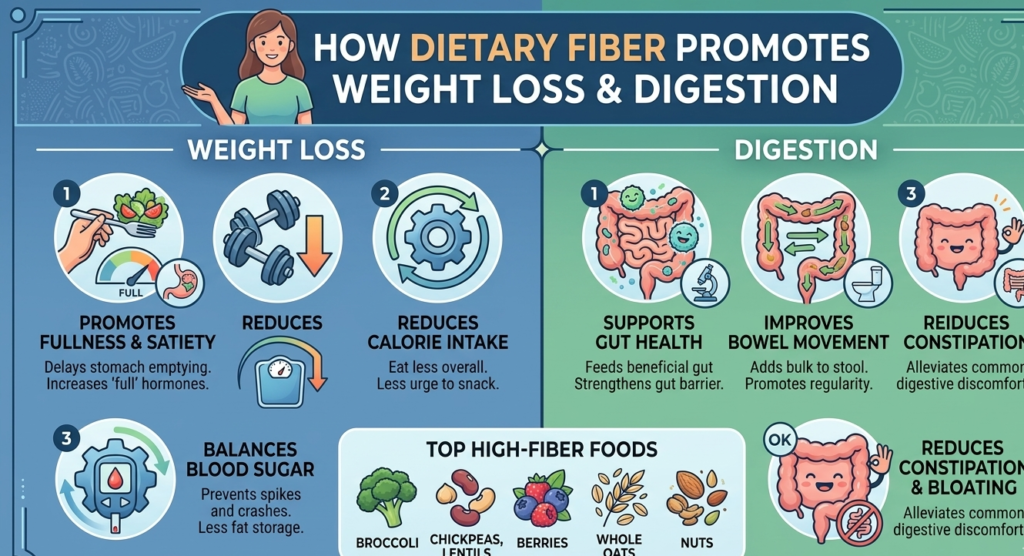
Before we answer how much fiber per day for weight loss you need, it helps to understand why fiber matters so much in the first place. Unlike carbohydrates, fats, or proteins, dietary fiber is not digested or absorbed in the same way. It moves through your gut largely intact, and that journey is what makes it so powerful.
How Fiber Promotes Weight Loss
- Slows digestion: Fiber slows the rate at which food leaves your stomach, keeping you feeling full for hours longer after each meal.
- Stabilises blood sugar: By slowing glucose absorption, fiber prevents the sharp blood sugar spikes and crashes that trigger hunger and cravings.
- Reduces calorie absorption: Some types of fiber bind to fat and calories in the gut, reducing how much your body actually absorbs.
- Feeds good gut bacteria: Fiber acts as a prebiotic, nourishing the gut microbiome bacteria that regulate metabolism, inflammation, and fat storage.
- Displaces calorie-dense foods: High-fiber meals naturally take up more space on your plate and in your stomach, crowding out less healthy options.
Understanding this is why the question of how much fiber per day for weight loss is more than just a number — it is about building a foundation for a healthier metabolism.
How Much Fiber Per Day for Weight Loss Do You Actually Need?
The general dietary guidelineshttp://U.S. Government recommend 25 grams per day for women and 38 grams per day for men. However, when it comes to how much fiber per day for weight loss specifically, research points to a higher target being more effective.
The Research-Backed Daily Targets
A landmark study published in the Annals of Internal Medicine found that simply aiming for 30 grams of fiber per dayhttps://www.who.int — without making any other dietary changes — led to meaningful weight loss. That is the number most nutrition experts now cite when discussing how much fiber per day for weight loss works best for adults.
Fiber Targets by Gender and Goal
- Women (general health): 25 grams per day
- Men (general health): 38 grams per day
- Women (weight loss focus): 28 to 32 grams per day
- Men (weight loss focus): 35 to 40 grams per day
- Active weight loss (all adults): 30 grams per day minimum — the most cited research target
💡 Quick Tip: Most people currently eat only 10 to 15 grams of fiber daily. Simply doubling your current intake could make a significant difference in your weight loss results.
So to answer directly: how much fiber per day for weight loss is most effective? Aim for 30 grams per day as your baseline, distributed across all your meals.
High-Fiber Foods Comparison Table — Best Sources for Weight Loss
Use this quick-reference table when planning your meals. These are the most effective high-fiber foods to help you hit your daily target for weight loss.
| Food | Serving Size | Fiber (g) | Best For |
| Chia Seeds | 2 tbsp | 10g | Belly fat |
| Lentils (cooked) | 1 cup | 15.6g | Appetite control |
| Black Beans | 1 cup | 15g | Blood sugar |
| Rolled Oats | 1 cup cooked | 4g | Morning satiety |
| Avocado | 1 medium | 10g | Healthy fats + fiber |
| Raspberries | 1 cup | 8g | Low-calorie snack |
| Broccoli | 1 cup cooked | 5g | Gut health |
| Pear (with skin) | 1 medium | 5.5g | Snacking |
| Flaxseeds | 1 tbsp | 3g | Belly fat |
| Almonds | 23 nuts | 3.5g | Energy + fiber |
The Two Types of Fiber and Which One Helps Most With Weight Loss
Soluble Fiber — The Weight Loss Powerhouse
Soluble fiber dissolves in water to form a thick gel in your digestive system. This gel slows digestion, reduces cholesterol, and dramatically improves blood sugar control. For weight loss, soluble fiber is particularly valuable because it suppresses appetite hormones and keeps you feeling satisfied between meals.
Best sources of soluble fiber: Oats, barley, legumes (lentils, black beans, chickpeas), apples, pears, citrus fruits, and flaxseeds.
Insoluble Fiber — The Digestive Regulator
Insoluble fiber does not dissolve in water. Instead, it adds bulk to your stool and speeds up the movement of food through your intestines. While it is less directly linked to appetite suppression, it plays an important role in gut health, regularity, and reducing bloating — all of which support a healthy weight loss journey.
Best sources of insoluble fiber: Whole wheat, bran, nuts, seeds, cauliflower, green beans, and potato skins.
Which Type Should You Prioritise?
Both matter, but when thinking about how much fiber per day for weight loss you need, prioritise foods that contain both types. Legumes, oats, and chia seeds deliver both soluble and insoluble fiber in a single serving — making them the most efficient choices on your plate.
What Is the 30/30/30 Rule for Weight Loss?
The 30/30/30 rule is a simple morning routine for weight loss that has gained significant attention in recent years. It involves eating 30 grams of protein within 30 minutes of waking up, followed by 30 minutes of low-intensity exercise. The rule was popularised by health researcher Tim Ferriss and later went viral on social media.
How Does the 30/30/30 Rule Relate to Fiber?
While the 30/30/30 rule focuses on protein and morning movement, fiber fits naturally into this framework. Pairing your 30-gram morning protein with high-fiber foods — think eggs with avocado on whole-grain toast, or a protein smoothie with chia seeds and berries — gives you both the satiety of protein and the slow-burning fullness of fiber.
A morning meal that combines protein and fiber essentially turbocharges the 30/30/30 approach. It sets your blood sugar on a stable track for the rest of the day, reduces mid-morning cravings, and contributes meaningfully toward your daily total of how much fiber per day for weight loss you need.
A 30/30/30-Inspired High-Fiber Breakfast Example
- 2 scrambled eggs — approx. 12g protein
- 1 slice whole-grain toast — 3g fiber
- Half an avocado — 5g fiber
- 1 small apple on the side — 4g fiber
- 1 scoop protein powder in water — approx. 20g protein
Total: ~30g protein + 12g fiber before 8am ✅
What Is the Best Fiber for Losing Belly Fat?
Not all fiber is equally effective at targeting belly fat. When it comes to visceral fat — the dangerous fat stored around your abdominal organs — one type of fiber stands out above the rest.
Viscous Soluble Fiber Targets Belly Fat Directly
Research published in the journal Obesity found that every 10-gram increase in soluble fiber intake was associated with a 3.7% reduction in belly fat accumulation over five years. The specific type responsible is viscous fiber — the kind that forms a thick, gel-like consistency in the gut.
The Top Fiber Sources for Belly Fat Loss
- Beta-glucan (oats and barley): One of the most studied fibers for reducing belly fat and improving insulin sensitivity.
- Psyllium husk: A concentrated soluble fiber shown to reduce waist circumference significantly in clinical trials.
- Konjac (glucomannan): A highly viscous fiber that expands in the stomach, creating extreme fullness with very few calories.
- Legumes (lentils, chickpeas, black beans): Deliver large amounts of viscous fiber alongside protein for a powerful belly-fat-fighting combination.
- Flaxseeds and chia seeds: Rich in soluble fiber and omega-3 fatty acids, which reduce inflammation linked to stubborn belly fat.
If reducing belly fat is your primary goal, focus on building your meals around these specific sources. Combined with understanding how much fiber per day for weight loss is ideal, targeting viscous fiberHigh Fiber Foods for Constipation: The Complete Guide to Natural Relief gives you the most precise results.
How Can I Hit 25 Grams of Fiber a Day?
Reaching 25 grams of fiber per day is very achievable once you know which foods to lean on. Here is a practical, meal-by-meal plan to help you hit your target without stress or complicated meal prep.
A Sample Day to Reach 25 to 30 Grams of Fiber
Breakfast — Target 9 to 10 Grams of Fiber
- 1 cup of rolled oats cooked: 4g fiber
- 2 tablespoons of chia seeds stirred in: 10g fiber
- Half a cup of mixed berries on top: 4g fiber
Breakfast subtotal: approx. 9 to 10g fiber
Lunch — Target 10 to 13 Grams of Fiber
- Large salad with mixed greens: 2g fiber
- Half a cup of chickpeas: 6g fiber
- 1 medium carrot grated on top: 2g fiber
- 1 slice of whole-grain bread on the side: 3g fiber
Lunch subtotal: approx. 10 to 13g fiber
Dinner — Target 10 to 12 Grams of Fiber
- Half a cup of cooked lentils in main dish: 8g fiber
- 1 cup of steamed broccoli: 5g fiber
- Half a cup of brown rice: 2g fiber
Dinner subtotal: approx. 10 to 12g fiber
Daily Total: 29 to 35 grams of fiber — well above the 25g target and approaching the 30g weight loss benchmark. ✅
💡 Quick Tip: You do not need to count every gram. Simply add one high-fiber food to each meal and you will naturally reach your daily target.
What Does 30 Grams of Fiber a Day Look Like?
Visualising 30 grams of fiber can make the goal feel much more real and attainable. Here is exactly what a 30-gram fiber day looks like in practical terms — real foods, real portions, no supplements required.
30 Grams of Fiber Visualised Across a Full Day
Morning
- 1 cup of rolled oats: 4g
- 1 tablespoon of ground flaxseed: 3g
- 1 medium banana: 3g
Mid-Morning Snack
- 1 medium pear with skin: 5.5g
Lunch
- Half a cup of black beans in a wrap: 7.5g
- 1 medium whole-wheat tortilla: 3g
Afternoon Snack
- A small handful of almonds (23 nuts): 3.5g
Dinner
- 1 cup of cooked broccoli: 5g
Running total: approx. 34.5 grams of fiber — achieved through ordinary, enjoyable foods without a single supplement. ✅
This breakdown shows that understanding how much fiber per day for weight loss you need is only half the challenge — seeing what it looks like on your actual plate is what makes it achievable every day.
Common Mistakes to Avoid When Increasing Your Fiber Intake
Increasing Fiber Too Fast
One of the most common mistakes people make after learning how much fiber per day for weight loss is ideal — is jumping straight to 30 grams overnight. This can cause bloating, gas, cramping, and discomfort. Instead, increase your intake by 5 grams per week until you reach your target.
Not Drinking Enough Water
Fiber absorbs water in your gut. Without sufficient hydration, high fiber intake can actually worsen constipation rather than relieve it. Aim for at least 8 glasses of water daily, increasing to 10 or more on days when your fiber intake is highest.
Relying on Processed Fiber-Fortified Foods
Fiber-enriched cereals, protein bars, and packaged snacks often contain isolated fiber additives that do not deliver the same benefits as whole food sources. Always prioritise whole fruits, vegetables, legumes, and grains over processed alternatives when calculating how much fiber per day for weight loss you are consuming.
Frequently Asked Questions — How Much Fiber Per Day for Weight Loss
Is 30 grams of fiber a day enough for weight loss?
Yes, 30 grams of fiber per day is the most commonly cited research-backed target for weight loss. Studies show that consistently hitting this number — even without other dietary changes — leads to measurable weight reduction over time. For most adults, 30g per day is both sufficient and achievable through whole foods alone.
Can too much fiber slow down weight loss?
Extremely high fiber intake above 70 grams per day can reduce the absorption of important minerals like iron, calcium, and zinc, which may negatively affect your metabolism and energy levels. For the vast majority of people eating 25 to 40 grams per day, however, there is no risk of slowing weight loss.
Does fiber cancel out carbs for weight loss?
Fiber does not cancel carbs, but it does reduce the glycaemic impact of carbohydrate-containing foods. When calculating net carbs — as used in keto and low-carb diets — fiber is subtracted from total carbohydrates because it does not raise blood sugar. Eating high-fiber carbs is always a far better choice for weight loss than refined, low-fiber carbs.
Should I use fiber supplements for weight loss?
Whole food sources are always preferable. Supplements like psyllium husk and glucomannan can be useful if you genuinely struggle to reach your daily fiber target through food alone, but they should complement a healthy diet — not replace it. Whole foods deliver fiber alongside vitamins, minerals, and antioxidants that no supplement can replicate.
What time of day is best to eat fiber for weight loss?
Eating fiber at breakfast is particularly effective because it sets your appetite hormones on a stable path for the rest of the day, reducing total calorie intake at lunch and dinner. That said, spreading fiber evenly across all three meals gives the most consistent benefit for both weight loss and digestive comfort.
Final Word: Make Fiber Your Weight Loss Foundation
Understanding how much fiber per day for weight loss you need is one of the most empowering steps you can take on your health journey. The target is clear: aim for at least 30 grams of fiber per day, focus on viscous soluble fibers for belly fat, increase your intake gradually, and distribute your fiber across every meal.
Unlike restrictive diets that cut entire food groups, building your meals around high-fiber whole foods is a sustainable, enjoyable, and evidence-based approach to weight management. It works with your body’s natural hunger signals rather than against them.
Now you know exactly how much fiber per day for weight loss works, you have the comparison table, the meal plan, and the real-food visuals to make it happen. All that is left is to start.
READY TO EAT MORE FIBER? START HERE.
Browse hundreds of high-fiber, weight-loss-friendly recipes at MealsMagic.net — all with full nutritional info, fiber counts, and step-by-step instructions. No complicated diets. Just real food that works.
👉 Visit MealsMagic.net to explore our high-fiber meal plans →
💌 Subscribe to the MealsMagic newsletter for weekly high-fiber recipes, meal prep tips, and weight loss guides delivered straight to your inbox.